Egypt Journal
Day 1: Arrival in Cairo
After a long journey across the Atlantic, including a pleasant stopover in Vienna, we finally arrived in Cairo and checked into the Four Seasons Hotel Cairo at The First Residence. As first-time visitors to Egypt traveling from North America with young children, selecting our accommodations was an important decision. We chose the Four Seasons because it provided a level of familiarity and confidence that helped ease concerns about language barriers, cleanliness, food safety, and security. When traveling to a destination that is new to us, particularly with family, those considerations matter.
Upon arrival, we decided to upgrade to a larger suite. The additional space immediately improved the experience, giving everyone room to spread out, relax, and recover from the long journey.
Rather than immediately giving in to jet lag, we headed to the pool for a light meal, a drink, and a swim. It was exactly what we needed after a day of airports and airplanes. The warm Cairo air and slower pace helped us transition from travel mode to vacation mode.
Determined to remain awake and begin adjusting to local time, we ventured out for an evening felucca ride on the Nile. Floating quietly along one of the world's most famous rivers after sunset was a fitting introduction to Egypt. The city lights reflected across the water while the sounds of Cairo drifted through the evening air. During the sail, the captain attempted to explain some of the fish commonly caught in the Nile and described the river's abundance. It sparked my curiosity about local ingredients and fishing traditions—topics I hope to explore further during this trip for future articles and writing projects.
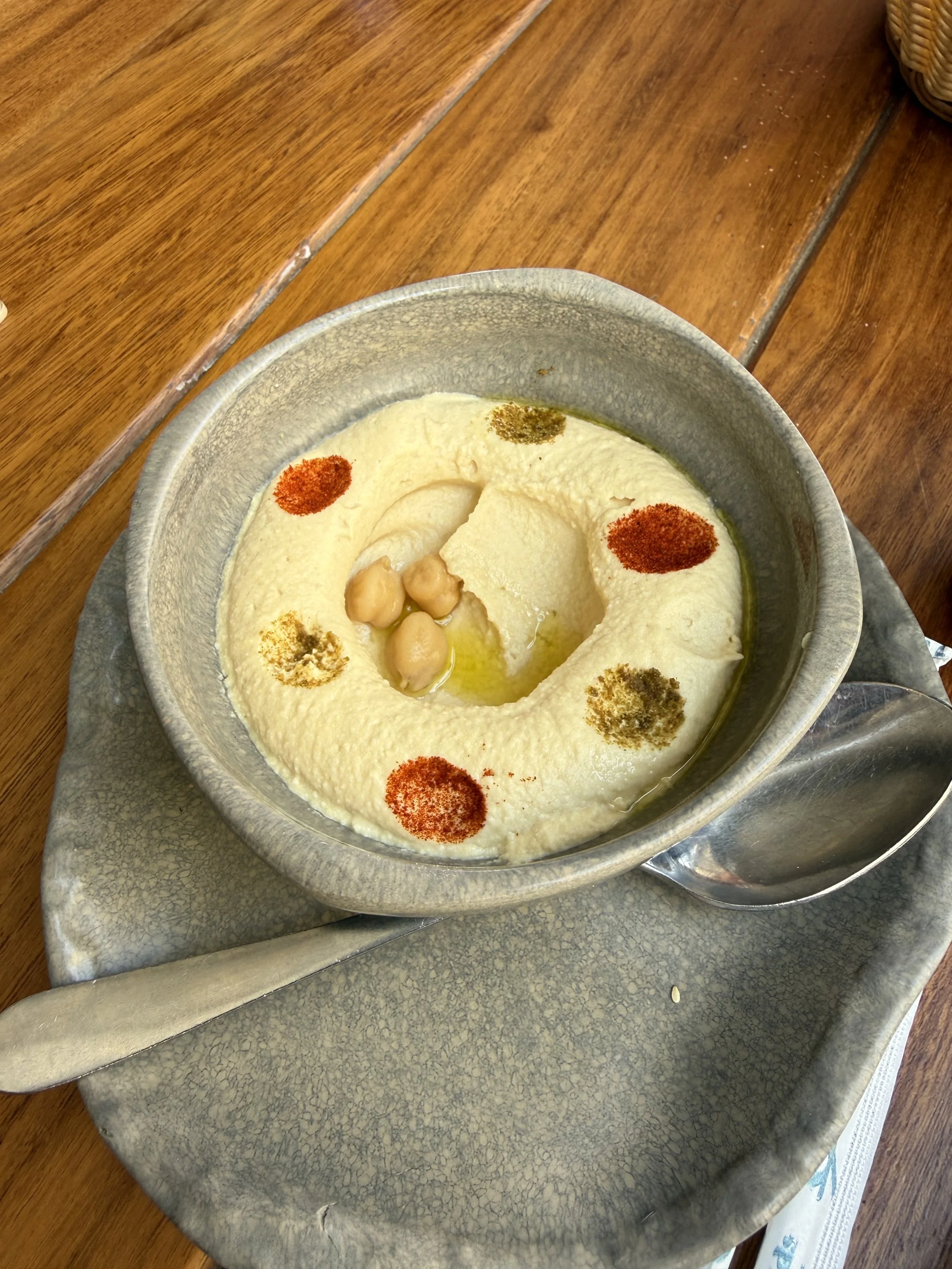
Back at the hotel, we enjoyed dinner at the Lebanese restaurant. While our first day's dining goals were simple—stay awake, get nourished, and avoid crashing from exhaustion—the meal quickly became one of the highlights of the day. The mezzeh was extraordinary. Every dish seemed to showcase layers of spice and flavor without overwhelming the palate. The hummus, in particular, was among the finest I have ever eaten. Its texture was impossibly smooth and rich, almost as though it had been made with French butter and cream. Whether that was actually the case hardly mattered; the result was remarkable. And then there was the bread—fresh, warm, and worthy of its own paragraph.
One dish stood above the rest that evening: the shawarma platter. After a long day of travel, it was exactly what I wanted. Rich, flavorful, comforting, and deeply satisfying, it was arguably the best thing I ate all day.
Beyond the food, the hospitality was impossible to ignore. Whether the experience was influenced by our suite upgrade or simply reflects the culture of the hotel, the level of service felt genuine. Every request, no matter how small, was met quickly and enthusiastically by multiple staff members. What stood out most was that the service never felt transactional. At no point did I feel anyone was helping because they expected a tip or because it was simply their job. The hospitality felt sincere, professional, and welcoming.
As dinner progressed, our children began to fade. Hours of travel had finally caught up with them. Yet, as often happens with young travelers, exhaustion did not immediately translate into sleep. After returning to the suite, our daughter found a second wind. What began as a sleepy evening quickly turned into a burst of energy as she ran through the hallways, explored every corner of our temporary home, and settled into an impromptu painting session before finally surrendering to sleep.
My first impression of Egypt is one of pride. Like many countries I have lived in or visited, there is a strong sense that Egyptians are proud of their nation and eager to share it with visitors. There is a visible appreciation for their history and their role as one of the world's earliest civilizations. Even within the first day, I sensed a genuine desire to welcome guests and showcase the best of Egyptian culture.
It is far too early to draw conclusions about Egypt's food culture or culinary traditions, but my goal throughout this journey is to better understand the relationship between food, hospitality, family, and community. If the first day is any indication, those themes will be present throughout the trip and will undoubtedly influence future articles, travel writing, and cookbook projects.
Day one ended with equal parts exhaustion, curiosity, and anticipation for what comes next.
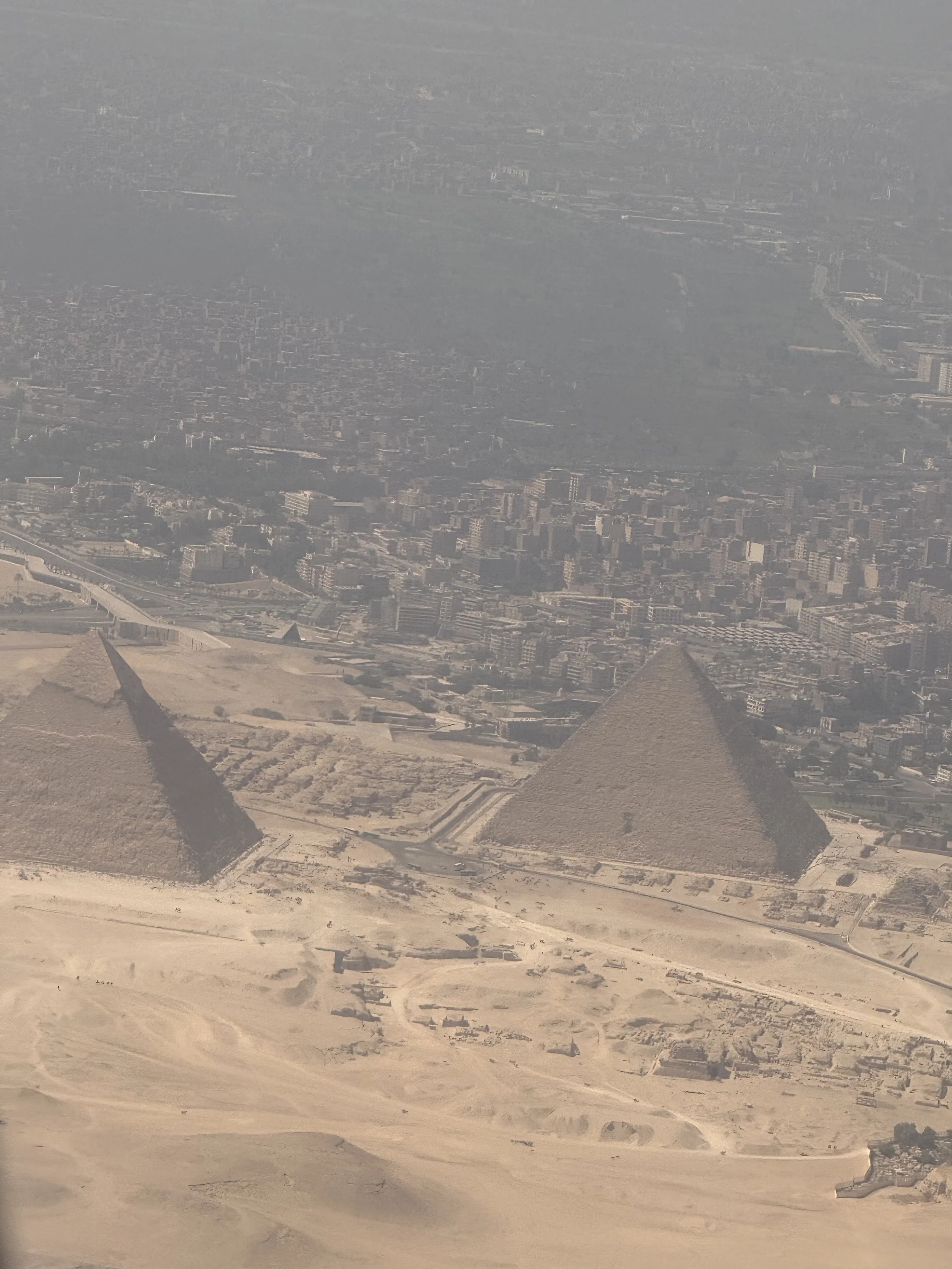
Left: Few travel moments compare to seeing the Pyramids of Giza appear beneath the wing of an airplane. As we descended into Cairo, excitement quickly replaced the fatigue of a long journey. To say they are awesome is an understatement.
Right: Two of the nine pyramids of the Giza Pyramid Complex rise above the desert, offering our first close look at one of the world's most iconic landmarks.
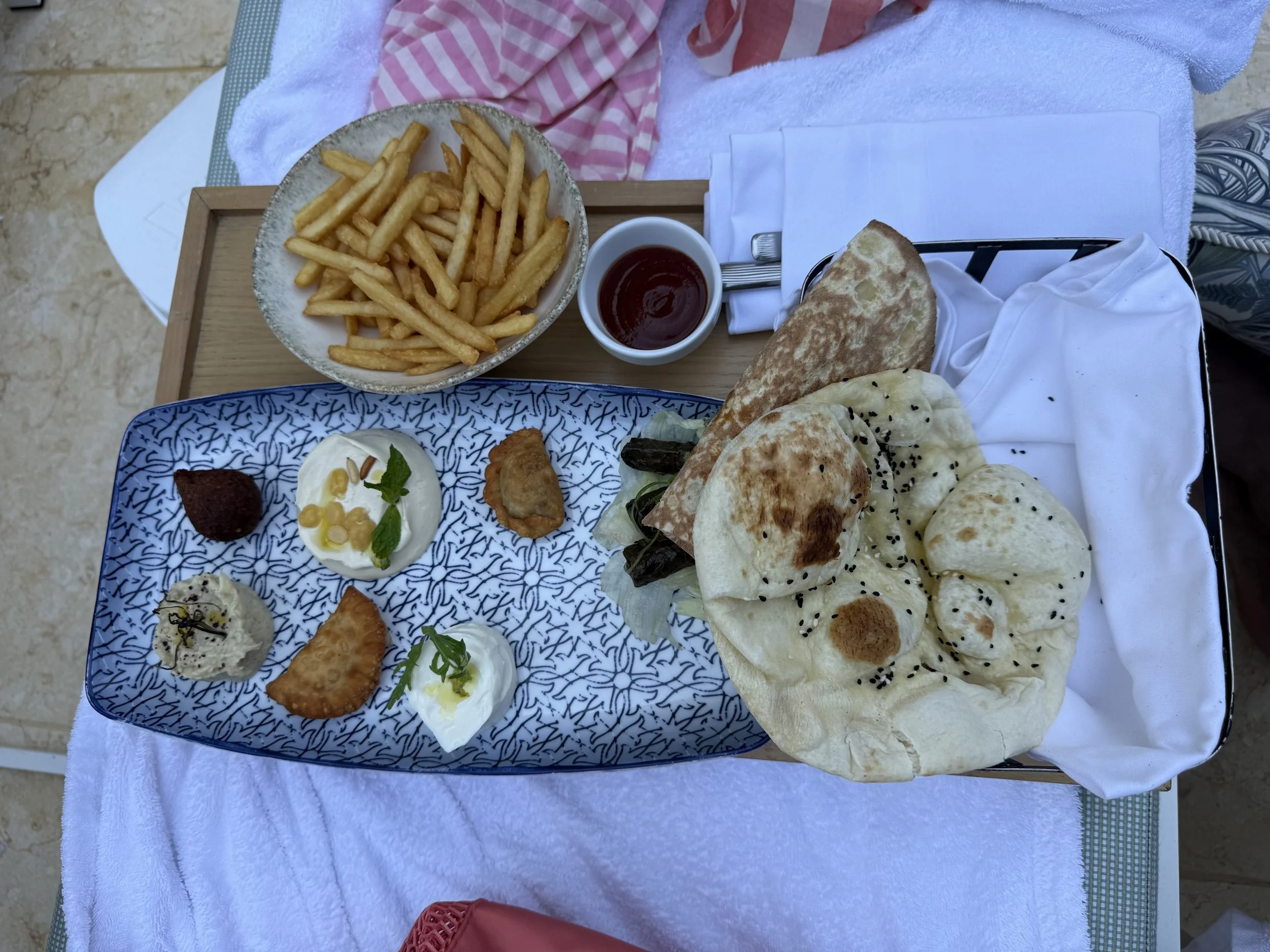
Our first snack in Egypt. This poolside Lebanese mezzeh was exactly what we needed after a long day of travel. The freshness of the ingredients and the balance of every dish made it one of the best meals of the trip.
Egypt Journal
Day 2
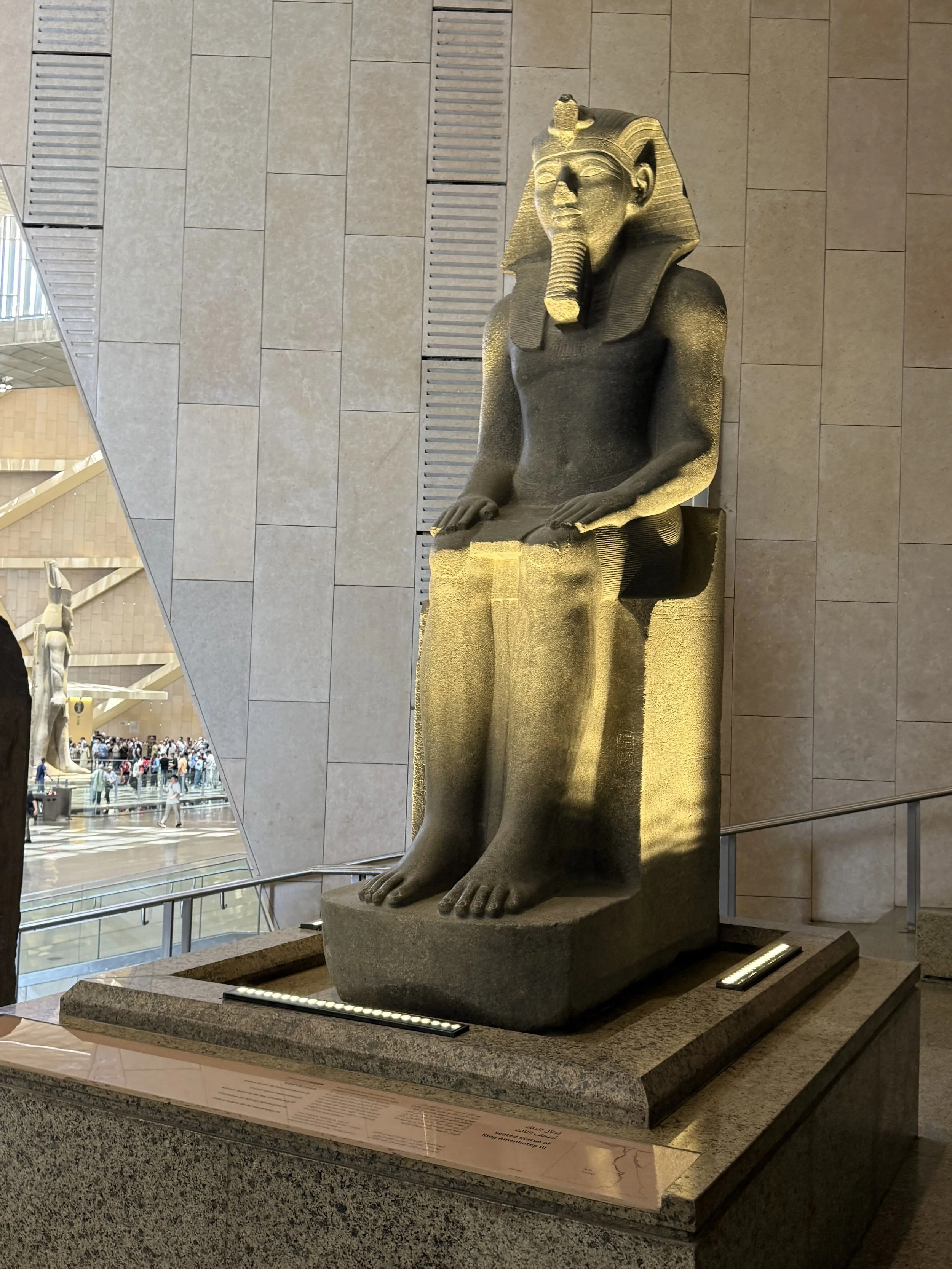
Our destination for the day was the Grand Egyptian Museum. To say the museum is large would be doing it a tremendous disservice. It is absolutely massive, housing thousands upon thousands of artifacts spanning one of the world's oldest civilizations.
Hiring an Egyptologist proved to be one of the smartest decisions of the trip. Anyone can walk through galleries reading display plaques, but having someone explain the historical context behind the artifacts transformed the experience from sightseeing into genuine learning.
One misconception he helped clarify involved the word "Coptic." Many visitors use the term "Coptic Christian" as though it identifies an entirely separate religion. Our guide explained that "Coptic" refers to Egypt's ancient heritage and language, while Christians in Egypt are simply Christians whose heritage traces back through those ancient Egyptian roots. It was an interesting historical distinction that I had never fully understood before arriving.
Although the museum contains countless treasures, my attention continually drifted toward anything involving food. Inside King Tutankhamun's exhibits were beautifully crafted vessels designed specifically for preserving food. Some were shaped to resemble the meats they contained, including poultry and larger cuts of meat. Unfortunately, I neglected to photograph these artifacts, but they fascinated me. Thousands of years before refrigeration, preserving food safely was already an advanced practice.
The conversation naturally shifted toward mummification. Hollywood has certainly taken liberties with the process over the years.
We learned that mummification generally began with an approximately seventy-day preparation period during which the body was dehydrated using natron, a naturally occurring salt mixture. The process itself reflected the importance ancient Egyptians placed on the afterlife.
Being a cook, I couldn't help but ask whether the salt was similar to the salt we use today. Our guide explained that ordinary people and royalty alike relied upon natron, although naturally the highest-quality materials were reserved for pharaohs and the elite.
I couldn't resist joking that once your blood pressure has officially reached zero over zero, sodium probably isn't your biggest concern anymore.
The museum continued to surprise me with evidence that ancient Egyptians clearly loved entertaining.
Serving platters.
Storage jars.
Bread molds.
Fermentation vessels.
Grain containers.
Woven baskets.
Everything suggested a civilization that valued hospitality, celebration, and communal meals. While historians debate who first brewed beer, there is little doubt that ancient Egyptians embraced it enthusiastically. Brewing, baking, agriculture, and food storage were woven into daily life. Looking through those exhibits, it became increasingly clear that food has always been central to Egyptian culture.
Following several hours at the museum, we returned to the Four Seasons for a relaxing afternoon by the pool. The hotel's wine selection immediately caught my attention. Egypt may not be the first country people think of when discussing wine, but the fertile lands surrounding the Nile have supported agriculture for thousands of years. It sparked my curiosity about Egyptian winemaking, something I hope to continue researching.
Another observation continued to reinforce itself throughout our stay. The produce. Fruit after fruit seemed sweeter than what we regularly purchase at home. My wife commented several times that, "This is what fruits and vegetables are supposed to taste like." Fresh figs. Melons. Stone fruit. Everything tasted vibrant and naturally sweet.
Our Egyptologist also explained that Egypt still recognizes its ancient agricultural calendar, built around three seasons: Flood, Cultivation, and Harvest. Considering how dependent civilization has always been on the Nile, it makes perfect sense that agriculture still influences life thousands of years later.
That evening we decided to experience traditional entertainment alongside dinner. After searching online for restaurants featuring belly dancing, our concierge recommended the Ritz-Carlton Cairo. On paper, it sounded perfect. Reality had other plans. A wedding had effectively taken over much of the hotel, forcing the restaurant to relocate to the pool deck. The venue itself was certainly pleasant, but it was not the elegant dining room we had envisioned when making the reservation. I couldn't help wondering just how important someone must be to essentially shut down portions of the Ritz-Carlton for their wedding reception. Still, travel is often about adapting.
Fortunately, the food completely redeemed the evening. We ordered an assortment of traditional Middle Eastern dishes including shish taouk, labneh, hummus, grilled accompaniments, and local breads. Once again, the hummus reinforced something I had already begun noticing during this trip.
Simple food executed exceptionally well often outperforms complicated food executed adequately. The hummus was silky. The labneh was rich and tangy. The grilled chicken was moist and beautifully seasoned. Fresh bread tied everything together.
The belly dancer was energetic, entertaining, and added exactly the cultural atmosphere we had hoped to experience. Although the unexpected venue change altered the evening, we still left satisfied.
As someone who tends to compare hospitality experiences wherever I travel, I found myself naturally evaluating the Ritz-Carlton against our own hotel. I have been a Marriott loyalist for years—Marriott, not Bonvoy—but after two days in Cairo, I found myself giving the advantage to the Four Seasons. Service felt more polished, dining more refined, and every interaction seemed effortlessly attentive. Luxury hotels all promise exceptional experiences. Some simply deliver them more consistently than others.
Today's experiences generated several ideas for future articles, recipes, and book chapters:
• Ancient Egyptian methods of food preservation using natron and clay storage vessels.
• Bread, grain, fermentation, and beer production in ancient Egypt.
• Comparative review of luxury hotel dining in Cairo.
• Middle Eastern breakfast traditions and adaptations within Islamic cultures.
• Egyptian agricultural traditions centered around the Nile.
• Egyptian wines and modern viticulture.
• Why exceptional hummus continues to prove that simple food, prepared with care, can rival the most elaborate cuisine.
• Hospitality observations comparing luxury international hotel brands operating in Egypt.
Day two reinforced something that had already become apparent after only forty-eight hours. Egypt is far more than pyramids, pharaohs, and monuments. It is a country where history still influences agriculture, hospitality, cooking, and daily life. For someone who writes about food and believes every recipe carries a story, Egypt continues to provide far more material than I could ever have expected.
Egypt Journal
Day 3
Giza, Great Pyramids, Great Hospitality, and the Pursuit of Great Hummus
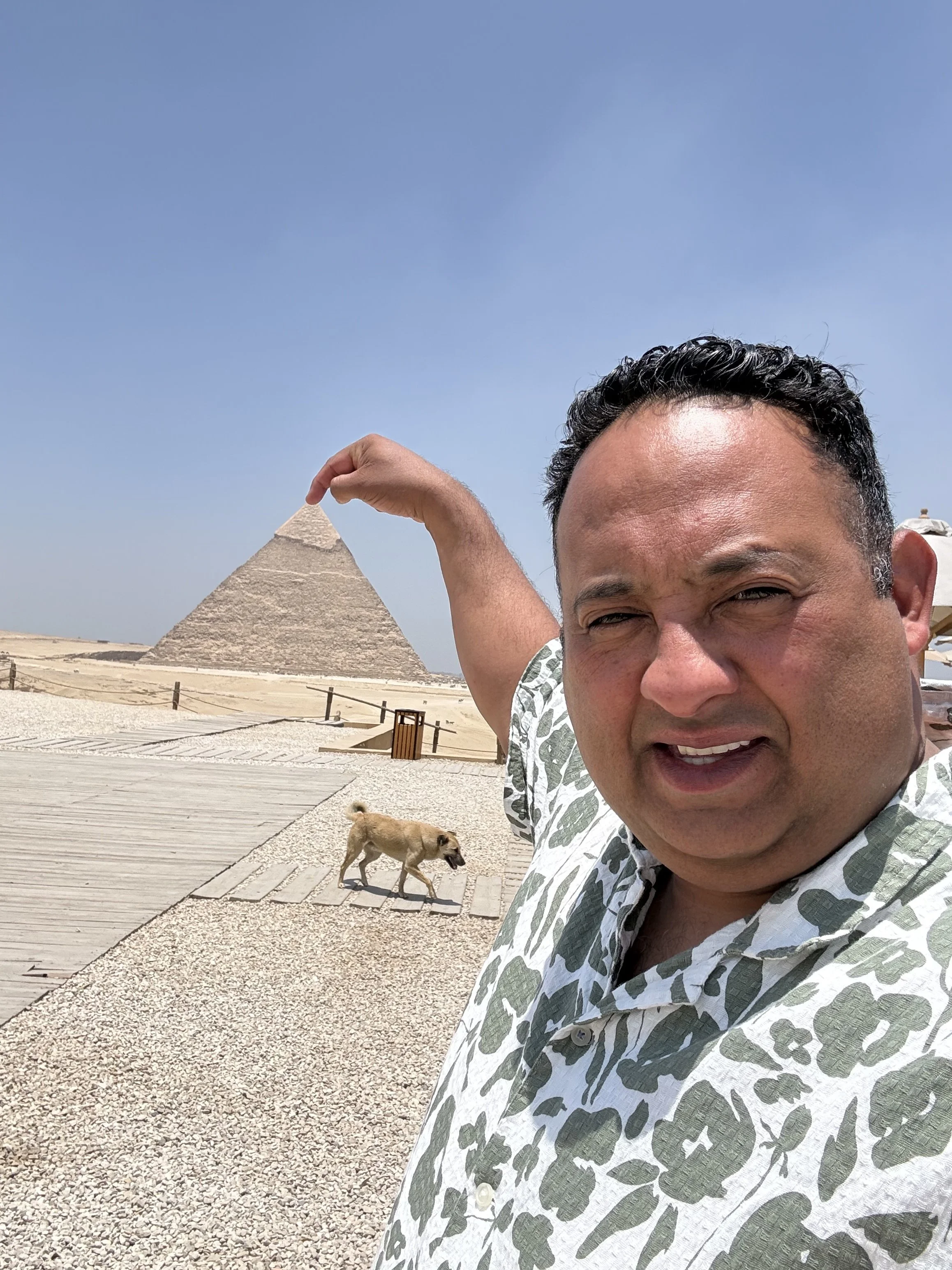
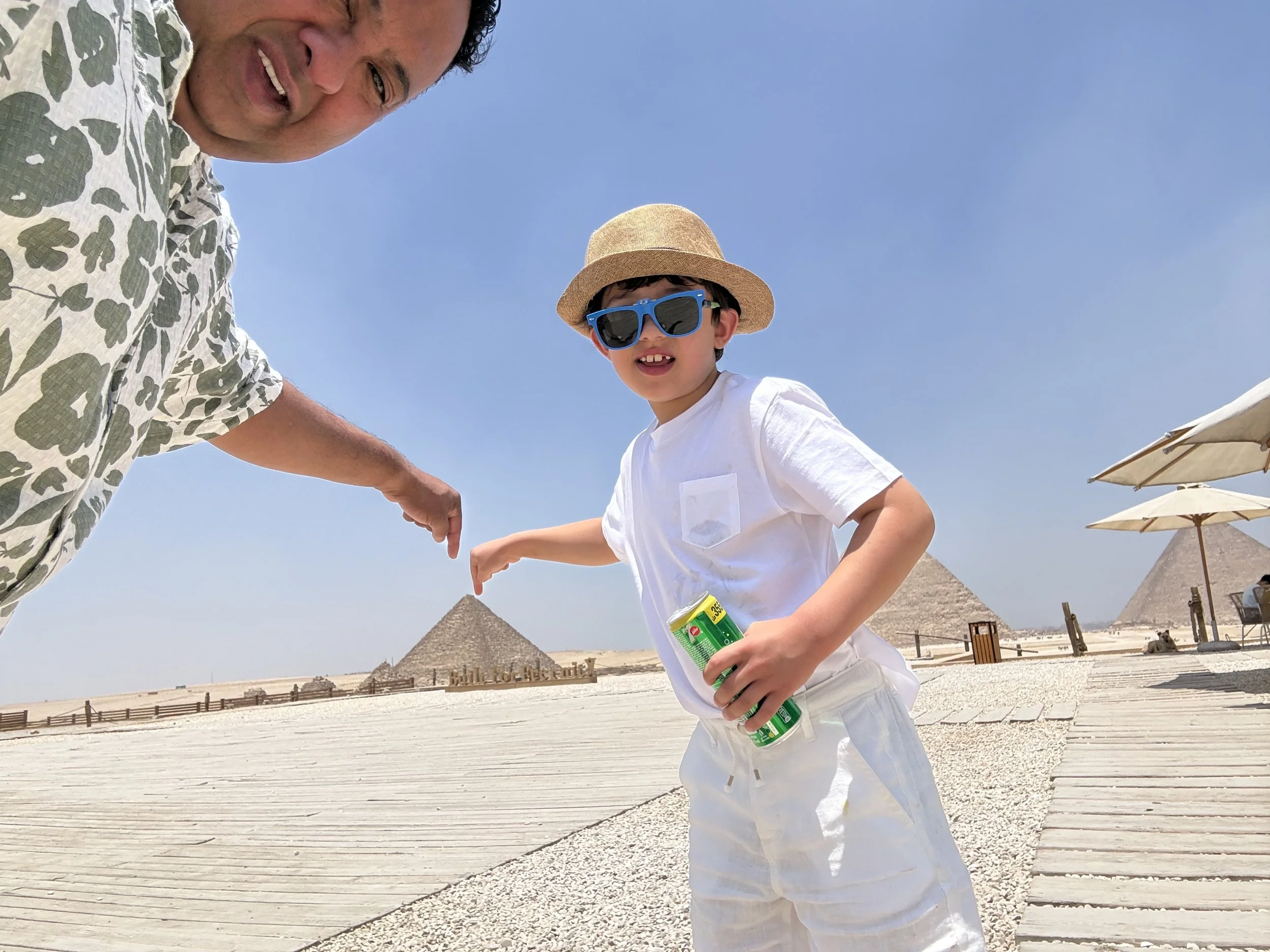
No matter how many photographs, documentaries, YouTube videos, history books, or Hollywood movies one consumes beforehand, nothing adequately prepares a person for the scale of the pyramids. Massive is an understatement. Standing at their base, they seem almost impossible. The structures are a testament to human ambition, engineering, organization, and perseverance on a scale that remains difficult to comprehend thousands of years later.
Much of our understanding throughout the day was made possible by our private Egyptologist guide, a graduate of Ain Shams University whose services were arranged through the Four Seasons. Her knowledge transformed what could have been a sightseeing excursion into a genuine educational experience. Throughout the day she discussed ancient Egyptian religion, royal dynasties, engineering, astronomy, burial customs, agriculture, and daily life along the Nile.
What impressed me most was not simply the depth of her knowledge, but her ability to communicate complex subjects in a way that remained engaging and understandable. Whether discussing celestial navigation, the alignment of monuments with true north, the role of food in religious ceremonies, or the lives of Egypt's rulers, she consistently provided context that brought ancient Egypt to life. She also possessed a quality I have come to admire in experts: despite her extensive knowledge, she remained intellectually curious and openly acknowledged that there is still much to learn about Egypt's past. My wife would also insist that I mention her photography skills, which helped capture several family photographs that otherwise would not have been possible.
The lessons from previous days were reinforced throughout the visit. Ancient Egypt was not merely a civilization of monuments. It was a civilization of food, agriculture, hospitality, religion, engineering, and community. The stories behind the stones often proved as fascinating as the stones themselves.
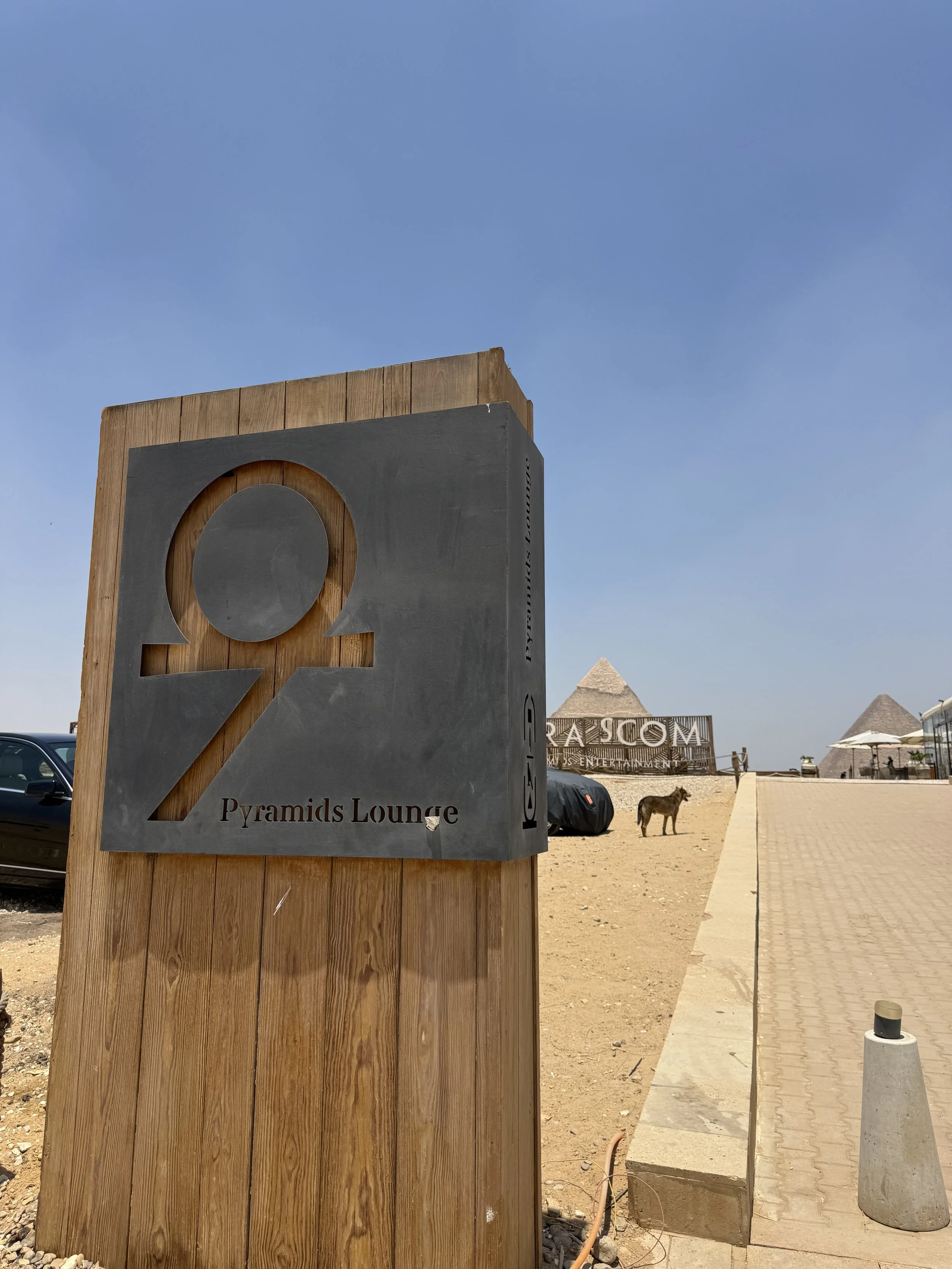
After spending several hours exploring the plateau, climbing viewpoints, considering whether to enter one of the pyramids, and enduring the desert sun, we stopped for lunch at Nine Pyramids Lounge. Prior to visiting Egypt, I spent considerable time researching food quality and food safety considerations. As visitors from North America planning an extended holiday, avoiding foodborne illness was naturally a concern. After reviewing available options, Nine Pyramids Lounge appeared to offer a combination of regional cuisine, professional hospitality, and a setting unlike any other.
The location itself is extraordinary. Situated directly within view of the pyramids, it provides what may be one of the most remarkable dining views anywhere in the world. While the food was not necessarily the primary attraction, the overall experience certainly was.
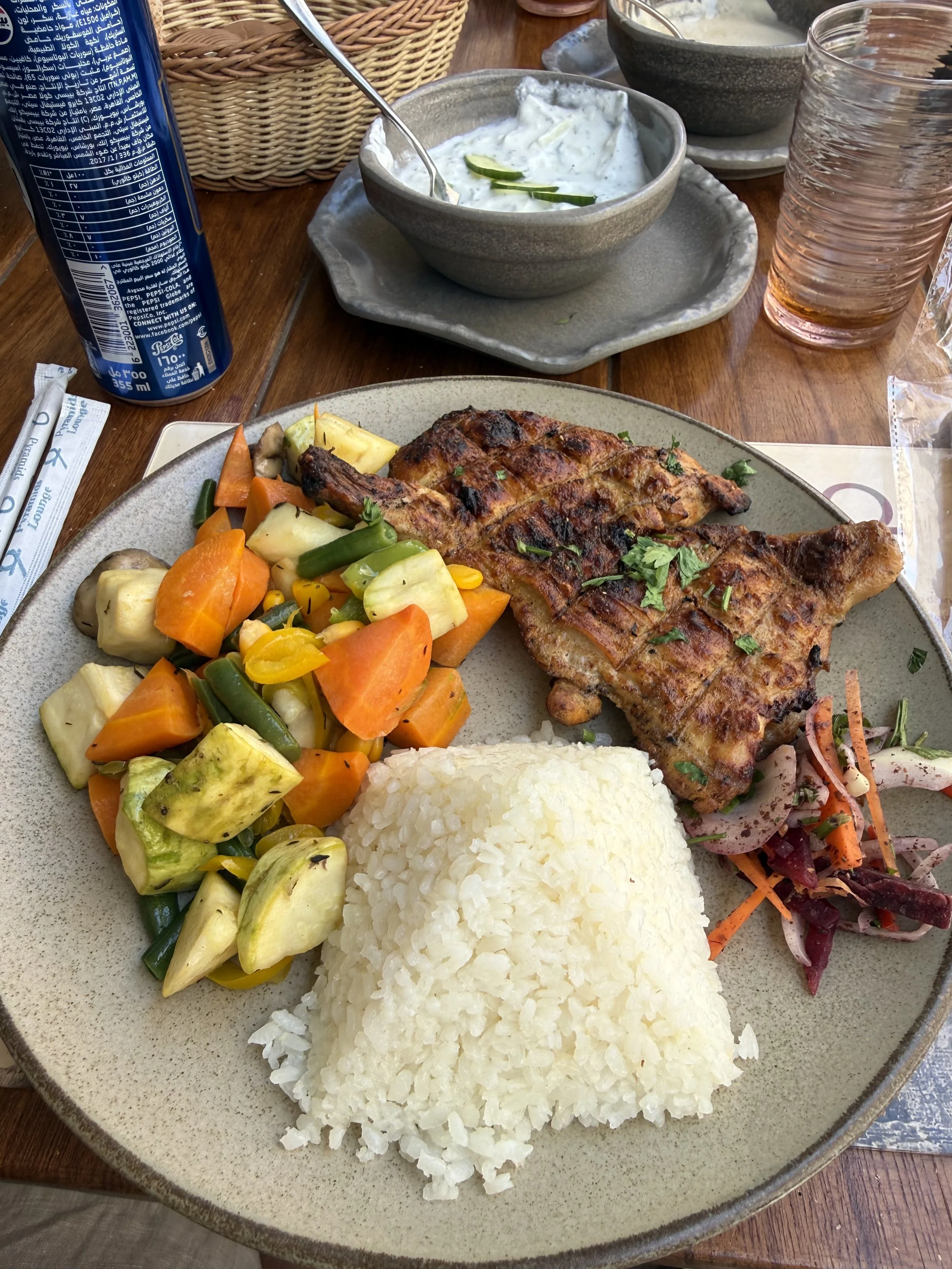
For lunch we ordered a variety of dishes including hummus, yogurt with dill, tahini, baba ghanoush, fried fish, grilled chicken breast, shish tawook, chicken fingers for the children, and mini burgers. The menu blended traditional Mediterranean offerings with dishes designed to appeal to international travelers. One item I noticed missing was koshari, the famous Egyptian combination of pasta, rice, lentils, and sauce that I had recently sampled at the Grand Egyptian Museum.
The food was competently prepared throughout. Nothing was overcooked, the fried items were crisp, and the grilled proteins remained moist. The hummus stood out as particularly memorable, possessing a nuttier flavor profile than many versions I have encountered elsewhere. While I personally would have preferred slightly more seasoning or perhaps a finishing salt, the dishes appeared intentionally balanced to accommodate a broad international audience.
One detail that immediately caught my attention was the presentation of the rice. Rather than simply scooping it onto the plate, the kitchen molded it into the shape of a pyramid. It was a simple touch, but one that connected the meal to its surroundings in a clever and memorable way. As someone who enjoys hospitality and food presentation, I appreciated the effort. It reminded me that presentation does not always require expensive ingredients or complicated techniques. Sometimes a thoughtful connection to place is enough to make a dish memorable.
Service was attentive and professional throughout the meal. One particularly memorable observation involved an older woman baking bread in a traditional outdoor oven despite the already intense heat of the day. Watching fresh bread being produced on-site added authenticity to the experience and offered insight into food preparation traditions that continue today.
If there is one criticism, it is that the food itself was overshadowed by the view. Yet perhaps that is precisely the point. Nine Pyramids Lounge is not solely a destination because of culinary excellence. It is a destination because it allows guests to sit comfortably, enjoy a meal, and stare at one of humanity's greatest achievements. I have eaten in many places throughout my life, and I honestly cannot think of another lunch view that surpasses this one.
One practical lesson from our day at Giza was the importance of staying hydrated. While a steady breeze made the temperature feel manageable, the Egyptian sun was far more intense than it initially appeared. After several hours walking around the plateau and exploring the site, water became less of a luxury and more of a necessity.
Bottled water is widely consumed throughout Egypt and appears to be the preferred choice for most visitors. One thing I noticed throughout the pyramid complex was the strong presence of Nestlé-branded bottled water, available at nearly every stop and concession area. Fortunately, before departing for the day's excursion, the Four Seasons provided our family with a cooler filled with ice-cold bottled water. This thoughtful gesture proved invaluable throughout the day. My advice for future visitors is simple: bring more water than you think you need. The breeze may convince you that conditions are comfortable, but the desert sun quietly drains your energy before you realize it.
After returning from Giza, the family needed to cool down quickly. We headed directly to the pool.
One aspect of this trip that deserves recognition is the level of care demonstrated by the staff at the Four Seasons. Throughout our stay, employees consistently focused on guest comfort and safety. Water was always available, shade was offered when needed, and staff frequently checked on guests to ensure everyone remained comfortable despite the summer temperatures.
A special mention goes to Mahmoud, one of the lifeguards, who kept a watchful eye on our children throughout our time at the pool. As a parent, that attentiveness provides tremendous peace of mind. He monitored the pool area with remarkable diligence. Since we are in Egypt, perhaps it is more appropriate to say he watched over the children like a falcon rather than a hawk.
Naturally, the afternoon eventually turned back toward food.
Once again, we ordered the mezze sampler platter. By this point in the trip it had become clear that sometimes the best strategy is simply to continue enjoying something that is consistently excellent. The hummus remained the standout item.
When the pool manager stopped by to check on us, I could not resist asking about it. Our conversation quickly shifted from hospitality to culinary technique. He explained that the chef responsible for the hummus is Lebanese and that one of the secrets to its remarkable texture is surprisingly simple: lots and lots of ice during preparation. According to him, the ice helps create the exceptionally smooth consistency that guests immediately notice.
As someone who enjoys cooking and recipe development, that small piece of information was worth the conversation alone. It served as another reminder that great food is often the result of mastering simple techniques rather than relying on complicated ingredients. It is a method I look forward to experimenting with when I return home.
One amusing moment occurred later in the day while riding an elevator. A hotel employee speaking on the phone mentioned that "Chef Nobu, the restaurateur, is here." As someone with a deep interest in food and hospitality, this immediately caught my attention.
Naturally, curiosity got the better of me. I embarked on what can only be described as a completely unsuccessful reconnaissance mission throughout the hotel. I made several laps through common areas, checked locations where I thought a celebrity chef might plausibly appear, and even convinced myself that perhaps a visit to the spa was warranted. Despite my efforts, I never found him.
Later that evening I discovered that the sighting had in fact been genuine. Social media posts from Cairo showed Chef Nobu Matsuhisa visiting both the pyramids and the Grand Egyptian Museum during the same period. It appears we missed him by only a matter of minutes.
My family found the entire episode highly entertaining. While I never had the opportunity to meet him personally, it served as a reminder of the global nature of hospitality and the culinary world. One moment you are discussing hummus technique with a Lebanese chef, and the next you discover one of the most influential restaurateurs in the world is walking through the same city and visiting many of the same historic sites.
The day concluded with dinner at Riviera, the hotel's Italian restaurant, and what may have been the most memorable meal of the trip thus far.
One thing worth noting for future visitors is the restaurant's dress code. While not overly restrictive, Riviera maintains a smart-casual standard. During a holiday where sandals and comfortable shorts become the default uniform, it required a bit of planning. Still, rules are rules. Much like the restrictions I encountered with my Meta glasses earlier in the trip, understanding expectations beforehand makes the experience smoother for everyone involved.
Our concierge, who has worked with us throughout our stay, once again demonstrated an uncanny ability to make things happen. By this point I had begun referring to him as a magician. Reservations, transportation, recommendations, and special requests all seemed to materialize effortlessly under his guidance.
The ambiance at Riviera immediately stood out. Bright, fresh, and elegant without feeling pretentious, the dining room transported me somewhere along the Italian coast. The menu itself reflected a similar philosophy: simple, focused, and confident.
We began with burrata, which looked every bit as good as it tasted. My daughter sampled burrata for the first time and immediately became a fan. Watching children discover a new food and genuinely enjoy it is one of the small joys of traveling as a family.
I also ordered the minestrone. While it contained many excellent components, it sparked an internal debate. Was the soup prepared incorrectly, or had my own expectations simply been shaped by previous versions I had eaten throughout my life? For my palate, the pepper was more prominent than I preferred. It was not unpleasant, merely different. Sometimes travel reminds us that what we believe to be a definitive version of a dish is often only one interpretation among many.
One unexpected highlight was the dinnerware. The pasta and soup bowls immediately caught my attention. I have been searching for plates with similar proportions and presentation characteristics for quite some time. Hospitality professionals often focus on food, but the vessels used to present that food are equally important in shaping the dining experience.
An amusing moment occurred when we ordered hot dogs for one of the children. Expecting something modest and familiar, we were instead presented with enormous hot dogs that appeared to be nearly a foot long. Calling them "hot dogs" almost undersells the experience. The sausage tasted as though it had first been smoked and then grilled, resulting in a depth of flavor that far exceeded expectations. Combined with properly prepared fries, it was an excellent example of how even a children's meal can be elevated through thoughtful execution.
The true stars of the evening, however, were the risottos.
We ordered both the Risotto Caprese and the Risotto Funghi. For the first time on this trip, I found myself struggling to describe a dish adequately. They were that good.
The seasoning was balanced. The rice was cooked properly. The presentation was elegant without becoming excessive. In particular, the contrast between the red sauce, fried basil, fresh basil oil, and creamy risotto created a visual presentation that was as compelling as the flavor itself.
More importantly, the dish immediately sparked ideas.
As a cook, there are meals you enjoy and then there are meals that make you start creating. This was the latter. Before the plate was even cleared, I was already considering how I might reinterpret the concept at home. Perhaps a risotto inspired by amatriciana. Perhaps burrata cream replaced with mozzarella pearls. Perhaps a variation that incorporates some of the lessons learned throughout this trip.
This is one of the highest compliments I can give a restaurant. The dish did not simply satisfy me. It inspired me.
Long after the meal ended, I found myself still thinking about it. I suspect I will continue thinking about it for quite some time.
As I returned to the room that evening, I realized that the day had been about far more than simply visiting the pyramids. It had been a day of learning, hospitality, culinary discovery, family memories, and inspiration. Some places live up to their reputation. Giza exceeds it.
As the sun began to set over Cairo, our felucca captain guided us along the timeless waters of the Nile. With the city's skyline on one side and centuries of history surrounding us, it was a peaceful introduction to Egypt unlike any other.